
A skincare label lists Diamond Powder. A product description talks about nanodiamond delivery. It is tempting to read those as two names for the same thing, but they answer different questions.
An ingredient name is only the starting point
An ingredient list tells you what went into a formula. It is not a diagram of how that formula works. Diamond Powder does not, by itself, tell you the size of the particles or whether another ingredient is attached to them.
That makes “Does this contain diamond?” a different question from “Does this use diamond particles to carry something?” A product description may explain the intended role; a study can show how a particular version behaved.
You do not need to become a materials scientist to follow the distinction. Start with two things: what is the diamond doing, and what ingredient is it doing that for? An answer such as “holding a particular ingredient at the skin surface” gives you more to work with than “advanced diamond technology.”
How a tiny particle can hold an ingredient
Nanodiamonds are very small diamond particles. Their surfaces can be modified with chemical groups that affect how they mix with water and hold other molecules. Molecules attaching to a surface is called adsorption. They sit on it rather than being swallowed inside the diamond.
Particles can also clump together. In Lim and colleagues' experiments, changing the solution's acidity changed the size of those clumps. The surroundings matter as well as the crystal.
A reservoir, rather than a shuttle
The same 2016 study paired modified nanodiamonds with eugenol, a compound found in clove. Across excised mouse skin, more eugenol passed through from the mixture than from eugenol solution alone.
The authors proposed a reservoir effect: particles held extra eugenol and released it as dissolved eugenol moved away. The mixture also contained more total eugenol, so this was not an equal-dose comparison.
In a separate pig-skin experiment, fluorescently labelled particles stayed at the outer barrier after 48 hours. The ingredient and its carrier can behave differently. These experiments studied model ingredients and animal skin, not a peptide facial serum.
That is the useful idea to take away: a delivery system does not always need to act like a vehicle driving through every skin layer. Sometimes its role is to manage the supply of an ingredient where it is applied. To understand a particular system, ask what was measured: the particle, the ingredient it held, or the skin's response.
Two descriptions, two different answers
Imagine comparing these two pieces of information. These are illustrative examples, not a comparison of two retail products.
Diamond Powder
You know diamond is present. The list alone does not explain its size, its role or whether it carries another ingredient.
Named particles + named ingredient
You can investigate the actual job: what was attached, what was measured and whether the tested system matches the one being described.
A more detailed description gives you a more specific question to ask.
For the ingredient-list example, you can simply look for an explanation on the product page. Does it discuss appearance, texture, holding an ingredient or another role? If no role is explained, leave it as an ingredient name rather than filling in the story yourself.
For the study example, follow the named ingredient. If the paper tested eugenol, it answers an eugenol question. If you are choosing a peptide serum, look for the connection to that peptide and formula. This is more useful than collecting impressive percentages from unrelated experiments.
A simple question for a brand is: “What does the diamond do in this formula, and where can I read about that particular system?” You do not need particle-size calculations to ask it.
Where this fits in a peptide routine
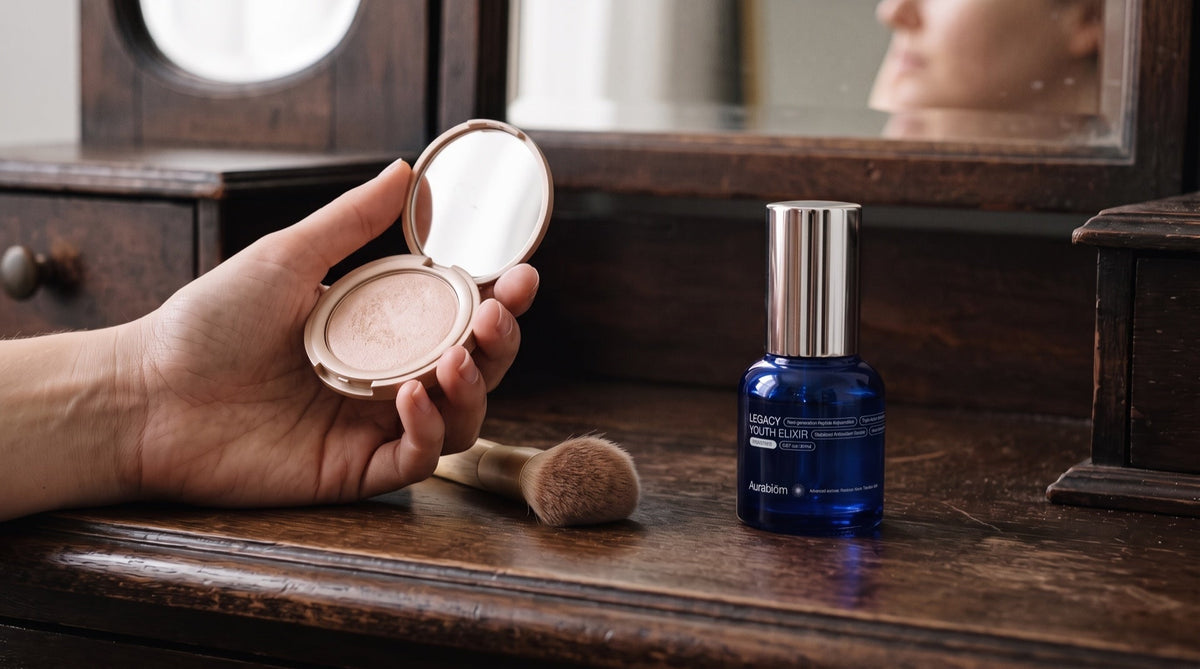
Legacy Youth Elixir's ingredient list includes Diamond Powder and Copper Tripeptide-1. You can explore the formula on the Legacy Youth Elixir product page. The eugenol experiment above is an explanation of a research concept, not a test of this serum.
If your next question is how peptides stay stable or move through skin, our guide to peptide delivery covers that wider picture, including liposomes and cyclodextrins.
When comparing products, keep the task manageable. Identify the role being described, then follow the ingredient the system is meant to help. That turns a technical-sounding term into something you can actually understand.