
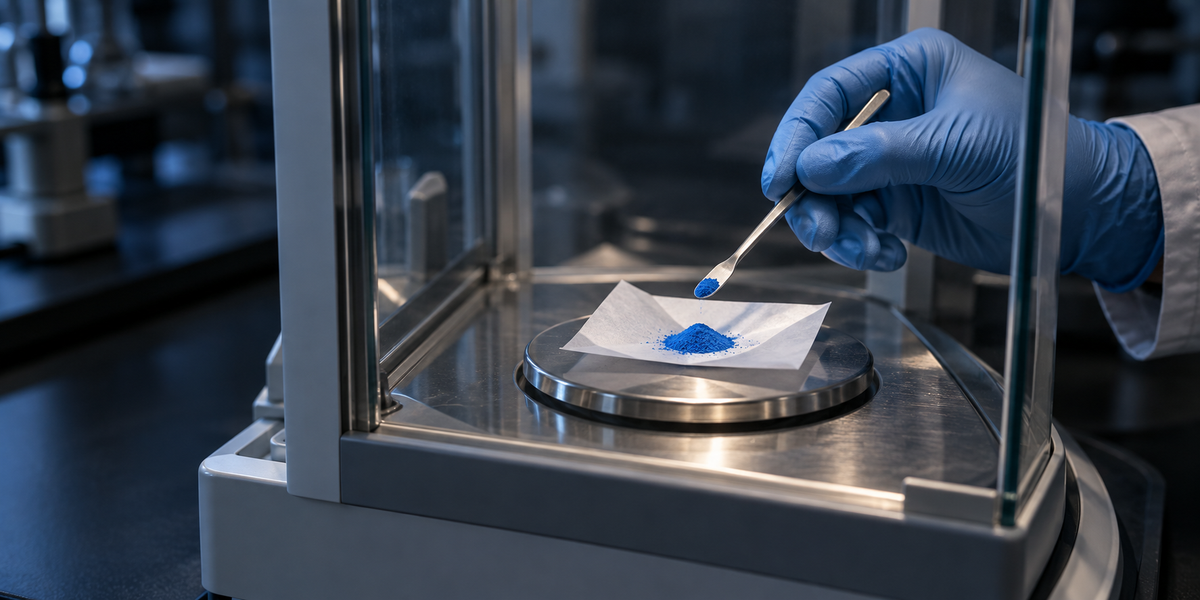
Three amino acids, bound to copper
GHK is a chain of three amino acids: glycine, histidine and lysine. That makes it a tripeptide. It was identified in human blood plasma, and it can bind copper. The copper-bound complex is GHK-Cu, known on skincare ingredient lists as Copper Tripeptide-1.
The two parts of the name belong together. Copper is held at attachment points on the peptide, forming a chemical complex. GHK without copper and GHK-Cu are related materials, but they are not interchangeable names for exactly the same thing.
That distinction matters when reading research. A result for the plain peptide, the copper complex or a modified version of GHK tells you about the material the researchers actually tested.
Why the copper matters
The bond is more than a naming detail. In a chemistry study by Lau and Sarkar, GHK could compete with albumin, a major blood protein, for copper in solution. This helped establish why researchers were interested in it as a possible participant in copper transport. It did not show where a copper-peptide serum goes after application.
There is also a useful biological comparison. Siméon and colleagues found that GHK-Cu increased an enzyme involved in tissue remodeling in cultured fibroblasts. Copper ions reproduced that particular response; GHK alone did not. So copper contributed to the response in that experiment. It was not simply an incidental ingredient alongside the peptide.
This gives us a reason to study the complex. To understand its relevance to skin, we need to look at what those cells were doing.
Skin is built and remodeled
Fibroblasts are cells that help make the framework around them. That framework, called the extracellular matrix, includes collagen and other structural material. It is continually maintained: cells make new material, break down some existing material and regulate that turnover.
GHK-Cu research touches both sides of this process.
What cells make
Maquart's fibroblast experiment found increased collagen synthesis without an increase in cell number. The cells' output changed; there were not simply more cells.
How material turns over
Siméon's fibroblast experiment found changes in a matrix-breakdown enzyme and in proteins that restrain such enzymes. This points to regulation of turnover, not just production.
These experiments measured cultured cells, not visible changes in facial skin.
The collagen experiment explains part of GHK-Cu's appeal. The remodeling result adds a less obvious point: an ingredient's biology cannot always be reduced to “more collagen” or “less breakdown.”
In the remodeling experiment, the enzyme was MMP-2, one of a family that helps break down matrix material. GHK-Cu also increased secretion of TIMP-1 and TIMP-2, proteins that help restrain those enzymes. Looking only at the enzyme increase would miss the accompanying controls.
The interesting idea is a change in the balance of building and turnover. Those cell findings make that idea worth investigating. They do not tell us how much of a serum reaches the relevant cells, or how much a wrinkle will change.
What a facial study can tell us
A human study asks a different question: does using a complete formula change something measurable on the face?
A 2016 study by Badenhorst and colleagues enrolled 40 women aged 40 to 65 in an eight-week trial; 39 completed it. Researchers tested Snowberry's New Radiance Face Serum, which contained GHK-Cu in a lipid-based nanocarrier. Each participant used the test serum on one side of her face and a comparison product on the other.
In the 20-person group comparing it with the serum base, the GHK-Cu formula produced a greater reduction in the measured depth and volume of a selected wrinkle near the eye. The measurement used three-dimensional optical imaging. This was a facial result, rather than a collagen measurement in a dish.
There are two important details behind that result. The comparison serum lacked both the GHK-Cu and its carrier, so the experiment did not separate their contributions. And the test serum was always used on the right side of the face, rather than randomly switching sides. The trial was small and funded by Snowberry in collaboration with Callaghan Innovation.
The result gives us a reason to take the tested formulation seriously. It does not establish the same outcome for every GHK-Cu serum. Nor does a change in wrinkle shape demonstrate that the cellular remodeling mechanism caused it: the laboratory experiments and the facial measurements answer different questions.
Reading a copper-peptide serum's evidence
GHK-Cu has a specific scientific rationale: copper binding, cellular responses and research on matrix remodeling. When that rationale appears beside a product, two questions help you decide what the evidence adds.
What was tested? Look for the exact peptide or the named finished formula. A cell study of GHK-Cu can explain the ingredient's potential. A study of one complete serum is more directly relevant to that serum.
What was measured? Collagen made by cultured cells, passage through a skin sample and wrinkle changes on a face are different observations. A useful explanation tells you which one occurred and keeps the result attached to it.
If your next question is how a peptide survives in a bottle and gets into skin, read our guide to peptide stability and delivery. If you already use a copper-peptide serum and are deciding where it fits with other actives, the peptide-layering guide covers that practical step.
Sources & References
2. Siméon A, Emonard H, Hornebeck W, Maquart FX. The tripeptide-copper complex glycyl-L-histidyl-L-lysine-Cu2+ stimulates matrix metalloproteinase-2 expression by fibroblast cultures. Life Sciences, 2000.
3. Maquart FX, et al. Stimulation of collagen synthesis in fibroblast cultures by the tripeptide-copper complex glycyl-L-histidyl-L-lysine-Cu2+. FEBS Letters, 1988.
4. Badenhorst T, Svirskis D, Merrilees M, Bolke L, Wu Z. Effects of GHK-Cu on MMP and TIMP Expression, Collagen and Elastin Production, and Facial Wrinkle Parameters. Journal of Aging Science, 2016.